
Therapy is Just Philosophy in Sweatpants
PROSE/POSTS
Manethon_Sega
5/20/20259 min read

Scene 1: At the therapist office, early winter morning, half of the light in his room is not working. we are sitting in opposite chairs, behind him on the wall tons of imaginary certificates:
So, he said the big question, the one they display on posters in yoga studios “What exactly do you plan to do with this one, presumably non-refundable, existence you've somehow landed in?”
“Nobody is going to save you,” he continues, voice low, like he’s just dropped a philosophical mic.
I shoot back, with the confidence of someone who just burnt their toast but pretended it was on purpose, “But I didn’t ask for saving! I’m perfectly capable of breaking down on my own!” But then, if we’re being honest, a tiny, whiny voice deep down —probably wearing a bathrobe and munching dry cereal—goes, “Wait, you mean no giant construction crane is coming to lift me? Not even a little tugboat to pull me out?”
Because let’s be honest: doesn’t everyone want to be saved a little? Preferably by someone brooding, and fluent in emotional sophistication and the artisanal ways of sourdough-making? I think part of us, apparently, is still standing by the shore, holding a sparkly sign that says “Rescue Me (Preferably With Snacks)”.
Honestly, most folks waltz into therapy expecting a psychic car wash – emerge sparkling clean, all the old shit gone, maybe even a new car smell. They think they're signing up for a personality transplant, hoping to trade themselves in for a better, less-terrified, version of themselves. But “better”? Better than what? A trash fire? An unpaid parking ticket? A rat fight in Paris behind a gas station?
What does better even mean? Like, less prone to crying during commercials? More skilled at parallel parking? That’s a sneaky little word, "Grrrr". does it mean peace? maybe?
Turns out, you might find something vaguely resembling "peace" in there (aka therapy), but it's probably not the fluffy, lie-on-a-cloud-eating-grapes kind you imagine. It’s the kind of peace that shows up wearing muddy boots and holding a shovel, whispering, “Hey, let’s dig through this emotional landfill and see what’s still breathing.”
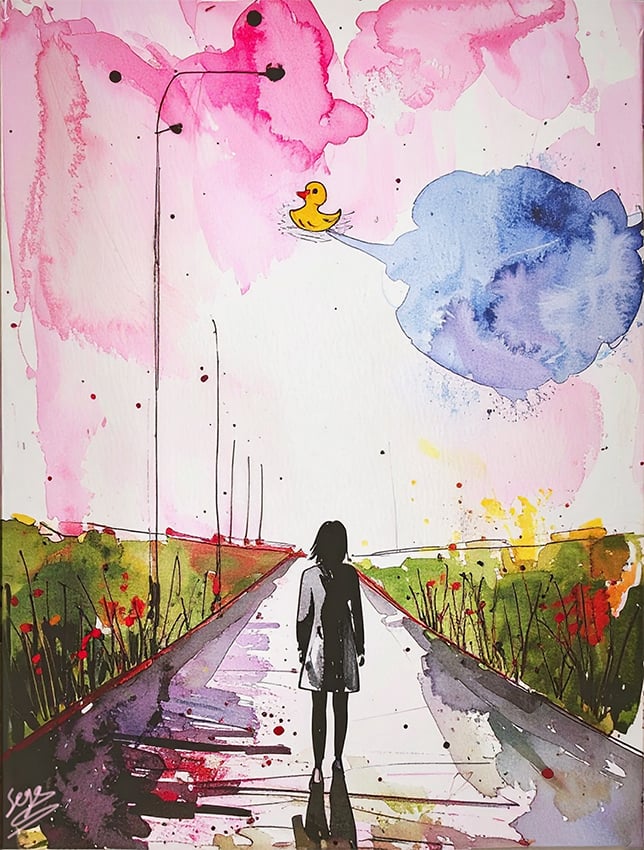
Because—brace yourself—PEACE isn’t some spa-day playlist of whale sounds and lavender mist. It’s more like trying to meditate inside a bouncy castle during a toddler rave and somehow, against all logic, finding one tiny corner in there that is just… quiet, and still being able to say, “Okay. I’ve got this. Sort of. Maybe. At least I’m not on fire.”. Peace isn’t the absence of chaos. It's having a small, calm rubber duck floating in your heart while the rest of you is being ripped apart by a philosophical hurricane and a thousand urgent emails.
______________
Scene 2 - The simple path to freedom maybe lies in changing perspective, not circumstance:
In the outside, some trees are still green, people talking in the distance and the sidewalk smells like wet leaves and regret. I am walking around talking to my imaginary best friend:
Look, let's just manage expectations here. I’m not under the delusion that therapy is some kind of magical vending machine where you insert pain and out pops eternal wisdom and inner peace wrapped in biodegradable packaging. It’s not going to erase all my problems, slap a “fixed” sticker on my forehead, or stop me from occasionally acting like a gremlin who skipped breakfast and read too many internet comments.
Therapists aren’t soul mechanics doing full personality swaps, sadly. You don't walk in feeling like a rusty spoon and walk out sparkling like a perfectly polished knife (though wouldn't that simplify things?). They’re more like those highly specialized mechanics who smooth out the dents on your soul. You know, the ones you get from emotionally crashing into strangers’ cars just because they cut you off in the grocery line. Therapists are helping us smooth out the sharp pieces of your soul so you're less likely to emotionally stab everyone, yourself included, every time you interact with the world. Maybe, if things go well, you cry a little less when someone uses the wrong tone in a text message, or you finally stop dating people who remind you of your emotionally unavailable cactus in your balcony.
In essence, it’s about figuring out what unusual brand of human you are, which, let's be honest, is usually a more terrifying prospect than facing a clown with a chainsaw. But here’s the twist, the kind of paradox that makes philosophers stroke their beards and then accidentally set them on fire: sometimes, to really identify yourself, you have to un-identify yourself. It feels suspiciously like being asked to find your car keys by first wiping your memory, losing the parking ticket, and realizing you never owned a car to begin with. That means actively un-knowing yourself and finally meeting the strange creature you already are—flaws, scars, weird internal monologues and all.
It’s about dumping out that carefully crafted, yet completely useless, instruction manual titled “How To Be Miserable, and Why It's Not Your Fault.” And realizing that the entire identity you've been clinging to might be less “truth” and more “bad improv character you’ve been playing for twenty years out of habit or spite.”
It’s about getting rid of the stale, over-rehearsed script you've been using—“I’m the one who always messes up,” “I don’t do vulnerability,” “My worth depends on productivity”—and realizing that maybe, just maybe, you can stop performing and actually start living. Not the story you’ve been narrating like a broken audiobook, but the life that’s been quietly waiting behind it, holding a sandwich and saying with googly eyes, “You done yet?”
You know what this reminds me of? There’s this story—kind of a sad joke, really—about a prisoner holding onto the bars of his cell, shaking them like he's warming up for a tragic musical. He's howling, desperate to escape, screaming about injustice and metaphorical cages and all that.
But here's the punchline: if he just turned his head a little to his left and right, he'd see there are no walls on the sides, it is just open air. All he had to do was take two steps sideways. But nope—he keeps shaking the bars like they owe him money.
That’s basically us, isn’t it? Screaming at problems like they’re a haunted empty vending machine in front of the cheapest hotel in Paris a rat can find, convinced we’re trapped, when in reality, doors are wide open and the only guard on duty is the panicked version of ourselves wearing a cheap plastic badge and yelling, “You shall not pass!”
A utilitarian side note: yeah, I know some bars are real steel. Like needing affordable healthcare, or escaping a war zone, or just making rent this month. This whole 'changing my story' thing feels huge for my head, but it doesn't exactly fix the broken system or put food on the table for everyone who needs it. Does focusing inside mean I'm ignoring out there?
______________
Scene 3: We are emotionally imprisoned, our feelings are a prison and our trauma is the warden.
Finally home after this long walk - sitting on the balcony - cold fresh air of a long winter night:
I close my eyes and exhale like someone trying to fog up a mirror. I start by picturing the prison—tiny, beige, and soul-crushing, like the waiting room at a government immigration office that forgot joy existed. The walls are that bland legal beige that screams, “We gave up decades ago,” and the bars? Thick, rusty, and definitely tetanus-positive. There I am, in the classic orange jumpsuit, because of course my imagination has a flair for cliché, gripping the bars like I’m warming up for a community theatre production of Existential Crisis: The Musical.
I’m howling to the heavens: “Get me out of here! Save me!” like someone stuck in a fridge and the lights are off. I glance left. I glance right. Then—wait for it—I do a double take so dramatic it would make a cartoon character blush. Wait. There are no bars there? And that’s when I feel it: a cosmic snap, like the universe just dropped a bowling ball of realization on my head.
Oh. Right. It's me. I'm the unpaid intern running this whole sad little prison operation. I felt lighter, felt less like liberation and more like suddenly realizing I had been trying to open a push door by pulling it for the last decade. Idiot.
I open my eyes, stare at myself in the reflection of the balcony door, like I'm catching a stranger stealing my identity. I nod—one of those slow, knowing nods people do in movies right before a dramatic plot twist. Yeah. I saw that. I saw you see it too.
I close my eyes again, but now I’m no longer gripping the bars. I’m walking around imaginary cell furniture. Literally just walking through the entire mess like it’s a badly parked shopping carts. A little cautious at first—because, let’s face it, freedom feels suspiciously like danger when you’ve been marinating in self-imposed doom for years. I got closer to the 'exit' and then I started running.
Running like someone just told me the ice cream truck only has one choco ice left. My feet hit the metaphorical grass, the breeze kisses my face like an over-enthusiastic aunt at a family reunion, and the sun is warming my skin like it forgave me for ghosting it all winter.
I run, and I run until my lungs start filing complaints and my legs feel like spaghetti in a windstorm. I stop. Look back. Expect prison guards, alarms, dramatic spotlights. But… nothing. Just the quiet, awkward silence of a plot twist no one paid attention to.
No guards. No locked gates. No warden twirling a metaphorical moustache.
Of course not.
Because the whole time, I was the one holding the keys... and also hiding them... in my shoe... while yelling about being trapped.
Turns out, the scariest part about being free is realizing you always were. Like finding out the monster under your bed was just a pile of your own dirty laundry, whispering “clean us” in the dark.
And now? I sit in the cold air, wrapped in a blanket that smells like old friends and half-baked hope, staring up at the sky like maybe it’ll text me back this time.
And for once, I don’t need saving. Just some tea. Maybe a snack. Possibly a nap. Definitely not a prison.
___________
Scene 4: not everything that hurts is deep.
After midnight - taking a well deserved pause from a lindy-hop party, standing in the open air buffing a cigarette in the cold with a friend, jazz music playing in the distance.
Most of us stumble into therapy feeling like we’re stuck in some invisible escape room designed by an over-caffeinated philosophy major student. We come in swearing we’re “trapped” by our own thoughts, behaviours, marriages, jobs, fears, or that one weird comment we made in 2007 that still haunts us at 3 a.m. And when life hands us two possible truths—I’m unloveable, or I’m actually kind of awesome—we often pick the one that hurts more, like emotional lunatics browsing the discount bin of self-worth.
Why? Who knows. Maybe because suffering is familiar and have a kind of horrible comfort, like wearing socks you haven’t washed in three weeks—they’re familiar, even if they reek. Maybe because we think if we pre-hate ourselves, it’ll hurt less when someone else does it. Either way, we keep tuning into the same busted brain radio stations—WTFM: All Anxiety, All the Time, K-TRST: Playing Nothing But Paranoia Since ’96. All full of static and self-sabotage. We forget we own the damn radio. Change the frequency. Jiggle the antenna. Hell, throw it out the window and try listening to something else for once—maybe something with jazz and less doom.
Because here’s the twist nobody really wants to hear: most of the time, the prison isn’t made of steel bars or your ex’s passive-aggressive text messages. It’s made of stories. Old ones. Ones you keep rereading like a tragic novel you pretend to hate but secretly in love with. And the thing is, no one's actually guarding the gate. You're just standing there, arms crossed, insisting you're locked in, when the door has been open this whole time, quietly squeaking in the breeze like, “Hey... uh... you coming or what?”
Insight—the real kind, not the inspirational-mug kind—lets you finally ask, Wait... am I doing this to myself? And if the answer is yes (which, let’s be honest, it usually is), that’s where things get interesting. Not easier. Just... realer.
And here’s where it gets uncomfortably poetic: the wound you’re avoiding? That painful emotional splinter you keep pretending is “fine”? That’s the damn portal. It’s not just pain—it’s GPS coordinates. Healing isn’t some enchanted forest where unicorns braid your hair and whisper affirmations. It’s more like crawling through the emotional version of an IKEA store with no map, losing a few screws (literally and metaphorically), and eventually managing to build a functional sense of self.
Because in the weird, chaotic evolution of consciousness, your biggest “WTF is wrong with me” moment might be the very shovel you need to dig yourself out. The wound isn’t just where it hurts—it’s where the light gets in, where the story shifts, where you stop being a background character in your own life and finally say, “Wait. This is my weird, awkward, chaotically hopeful script now.”
And if that’s not evolution of consciousness, I don’t know what is. Sometimes growth doesn’t look like a blooming flower—it looks like a rat crawling out of a dumpster with a half-eaten donut and saying, “You know what? This isn’t rock bottom. This is breakfast.”
So yeah. There is a way out. But you’ve got to be willing to stop screaming at the bars and notice they’re made of cardboard, not steel. You’ve got to stop waiting for someone to save you and realize you’re the one holding the metaphorical bolt cutters—and possibly a sandwich. Because let’s be real: nothing fuels emotional liberation like carbs.
So yeah. Change the station. Step out of the cell. Or at least stop licking the bars like they’re going to give you answers.
And if all else fails? Start with this: take a breath. Light a metaphorical cigarette. Listen to the jazz. You're already more free than you think, and I love you.
Manethon_Sega
Sei Pippi, nicht Annika
Explore creativity through words, art, and music.
© 2024. All rights reserved.