
The Snake and the Saw: A Meditation on Self-Inflicted Warfare
PROSE/POSTS
Manethon_Sega
4/6/20268 min read
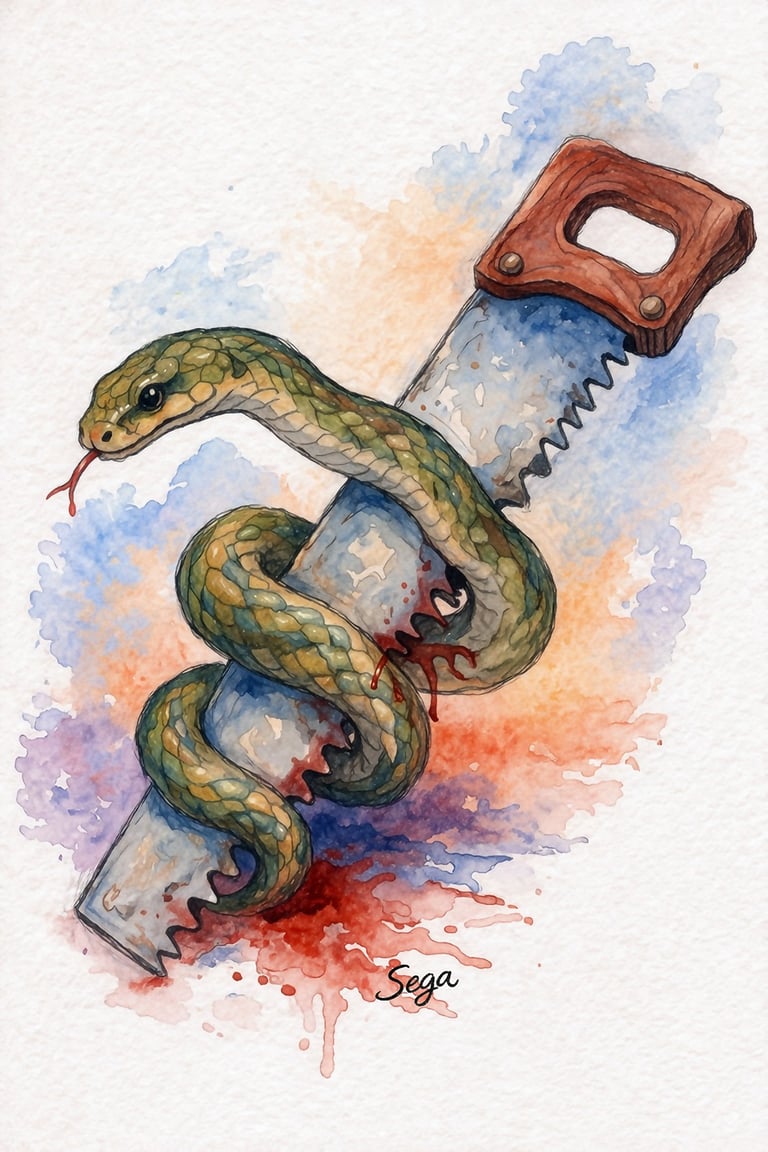
A snake once slid across a saw and got cut. Not badly, just enough to feel it. What happened next is the part worth sitting with: instead of pulling away, the snake wrapped itself around the blade, kept squeezing, and bled to death winning an argument with a piece of steel. The saw, being a saw, did what saws do when you press flesh against them. The snake squeezed harder. This continued until there was no snake left to squeeze.
There is something almost noble in its commitment. Almost.
What the snake experienced, in those final moments of maximum effort, was not combat. It was meaning-making, which is arguably more dangerous. The saw had not threatened the snake. The saw had not threatened anyone. The saw was doing what saws do in the absence of human hands, which is: absolutely nothing. It simply existed in space. It had no opinions about snakes. It had no opinions at all. Philosophically speaking, it was the most enlightened being in the story. But the snake had already narrated the encounter, already decided what the contact meant, who had been wronged, and what honour required, and once that story started, there was no stopping it. The saw was the villain now. The saw would be made to understand.
The saw, meanwhile, remained spectacularly uninterested. It had no grudge to settle, no lesson to teach, no dark monologue. It was a saw.
_______________
This is the part worth sitting with, because we do this constantly, and with considerably more sophistication than snakes, which is the problem. We are very good at the story. We have whole internal production studios dedicated to the story. complete with score, lighting, and a clear moral arc in which we are the wronged party and the saw is basically a monster.
A pause in conversation becomes rejection. A delayed reply becomes disrespect. A raised eyebrow becomes contempt. A mistake becomes identity. One awkward silence at dinner and suddenly the psyche has produced a theatrical piece called "Everyone Secretly Regrets Knowing Me".
None of these things are necessarily happening. But the nervous system doesn't particularly care about "necessarily." It cares about pattern-matching at speed, and it is, frankly, too good at its job. The pulse jumps first. The stomach tightens. Shoulders rise. Jaw locks. Breathing turns shallow and bureaucratic, like it is filling out forms instead of keeping you alive. The nervous system is a fast, loyal idiot. It is not evil. It is not stupid in the ordinary sense. It is just ancient, and ancient things prefer false alarms to funerals.
Here's what's actually happening, biologically, before any of your more sophisticated faculties get involved: your threat-detection hardware, ancient, fast, and somewhat paranoid, fires before your prefrontal cortex has had a chance to weigh in. The amygdala does not wait for context. It sees a shape in the dark and it reacts, and only afterward does the slower, more deliberate part of your brain show up to either confirm or walk back the alarm. By that point, though, you're already squeezing. The tightening has begun. You are composing the email in your head. You are planning what you'll say. You are rehearsing the argument that will make everything make sense.
The whole apparatus is remarkably efficient at generating suffering out of ambiguous raw material.
That is the awkward truth beneath a lot of our drama: the body is frequently trying to save a life the mind hasn’t yet realized is not under attack.
By the time thought arrives, it often comes not as a neutral investigator but as a press secretary. It does not ask, What happened? so much as it says, I see we are feeling endangered. I will now assemble a compelling explanation. And the explanation will usually try to flatter our alarm. It will make it feel justified, principled, even profound. The ego loves a dramatic interpretation. It would rather be tragically wrong than mildly embarrassed.
This is why reactivity feels so convincing. It arrives with sensations, and sensations have an authority abstract reasoning can only dream of. If your chest is tight and your skin is hot, if your heart is kicking the inside of your ribs like it has found a new religion, then of course the thing in front of you must be serious. The body says emergency, and the mind, eager little intern that it is, starts printing meaning on company letterhead.
_____________________
Viktor Frankl, who spent years in Nazi concentration camps and came out of it with what might generously be described as some perspective, identified this: the sliver of space between stimulus and response, the micro-pause where all of human freedom apparently lives. That gap is not a gap between feeling and not feeling. It is not the gap where you transcend your nervous system, because no one transcends their nervous system; we are mostly just riding it and pretending we're driving. The gap is something smaller and more achievable. It is the moment "barely a moment" where you could ask: what does this actually mean? And: does it have to mean that?
Phenomenology, which is a grand name for the humble act of noticing what experience feels like from the inside, is helpful here. Before an event becomes a story, it is a sensation. A contraction. A heat. A narrowing. The world subtly changes shape. Attention tunnels. Possibilities shrink. What a calm observer would call “uncertainty,” the activated body calls “incoming catastrophe.” Reality does not only get interpreted. It gets felt into a form. And once it has been felt that way, the meaning can seem less like a choice than a revelation.
This is one reason stillness unnerves people who are wired for reaction. Stillness sounds noble in theory. In practice, it can feel like standing unarmed in a room where the old machinery of self-protection has been unplugged. If a person has learned, through chaos or criticism or inconsistency, that safety depends on being quick, then pausing will not feel peaceful. It will feel negligent.
What makes this hard is that stillness feels like losing. We are culturally, neurologically, and in some cases spiritually inclined to interpret a pause as a failure of will. To not react is to accept the situation. To not squeeze is to lie down and let the world run over you. Calm, in this framing, is what you call surrender when you're trying to make it sound dignified.
The system will read non-reaction as exposure. Don’t just stand there, it says. Interpret. Defend. Anticipate. Tighten. Surely vigilance is the same thing as intelligence.
It is not. But it can impersonate intelligence very convincingly.
A lot of people live this way and call it insight. They are not calm because calm, to them, resembles losing. They confuse readiness with tension, wisdom with suspicion, strength with perpetual internal bracing. If you have been rewarded for being the first to detect danger, or punished for missing it, then stillness can feel less like peace and more like treason against yourself.
This is where the distinction between two kinds of calm becomes important. There is a version of calm that is really surrender in a cheap disguise:
It is suppression, which is its own kind of catastrophe. The emotional equivalent of telling the smoke alarm to shut up while quietly hoping the house isn't actually on fire. Suppression is squeezing with the lights off.
Then there is another kind of calm that has nothing to do with resignation.
The kind that surgeons and hostage negotiators and people who defuse unexploded ordnance for a living carry into the room with them. Not the calm of someone who has stopped caring, but the calm of someone who has decided not to hand the controls over to the loudest alarm in the system. Power under control, which is a different animal entirely from power abandoned. It is, if anything, the harder thing, the more demanding discipline. Anger is easy. Reaction is free. Choosing, in the quarter-second before the tightening, to ask what is actually happening here: that costs something.
____________________________
This calm does not come from giving up meaning. It comes from loosening your first, most panicked interpretation of it. It is not the absence of feeling but the refusal to let feeling seize the steering wheel and drive into a ditch while shouting about principles. It is a pause with muscle in it. Not collapse. Not passivity. A held center.
This kind of calm is often misunderstood because it lacks theatrical flair. It does not make an impressive entrance. It is not loud. It does not throw cutlery. It does not post cryptic messages. It does not pace the apartment rehearsing rebuttals like a lawyer preparing for a trial no one else knows is happening. It simply inserts one radical possibility into the sequence: perhaps this does not mean what my first wave of panic says it means.
That small interruption changes everything.
The old philosophers treated this as character. The Buddhists treated it as awareness. Cognitive science would probably describe it as top-down regulation modulating limbic response, which is true, but has all the romance of an insurance pamphlet. In ordinary terms, it is the moment a person notices the rising tide and does not immediately build a religion around it.
(The Buddhists called the capacity for this sati, it is bare attention, witnessing without immediately becoming. The Stoics called it the work of the rational faculty distinguishing between what is genuinely threatening and what merely feels that way from the inside of your particular nervous system, on this particular afternoon, given everything that has happened to you in the past and everything you're worried might happen in the future.)
None of this means the world contains no genuine threat. Some saws are not metaphors. Some criticisms are meant to humiliate. Some silences are cold on purpose. Some people are, in fact, dreadful. Calm is not pretending otherwise. It is not becoming naive or infinitely accommodating or spiritually beige. It is the capacity to meet what is actually there without adding three extra injuries made of interpretation, pride, and old memory.
____________________________
The difficult news "and there is always difficult news," is that the saws in your life won't apologize for being where they are. They will not acknowledge the disruption they caused, or validate the indignation you felt, or appreciate how much you've grown from the experience. They will continue being what they are: sharp things you brushed against, at speed, in the dark. The meaning was always going to be yours to assign. It was always going to be your call, in that fraction of a second, whether to slither on or make it mean something it couldn't survive meaning.
That is why the pause matters. Not because every pause reveals peace, but because without it, every sensation gets promoted to prophecy.
The snake had no pause. It had velocity, and story, and the absolute conviction that it knew exactly what was happening.
And maybe that is the hardest thing to admit: a great deal of suffering comes not from what happened, but from the speed with which identity rushed in to narrate it. The bruise was real. The humiliation, betrayal, cosmic condemnation, and lifelong proof of unlovability may have been a committee decision made under terrible conditions.
Mastery, then, is not serene detachment in the spa-brochure sense. It is more like composure under internal weather. It is being able to feel the first surge of heat, fear, insult, urgency, and still not kneel before it. To let the body ring its alarm bell without assuming the house must therefore be on fire.
That kind of freedom is unspectacular. It will not get a standing ovation. No one claps when a person decides not to turn discomfort into doctrine. But whole lives are quietly altered there, in that almost invisible interval where one can either tighten around the blade or notice, with some humility and maybe a little embarrassment, that the thing drawing blood is no longer the world alone.
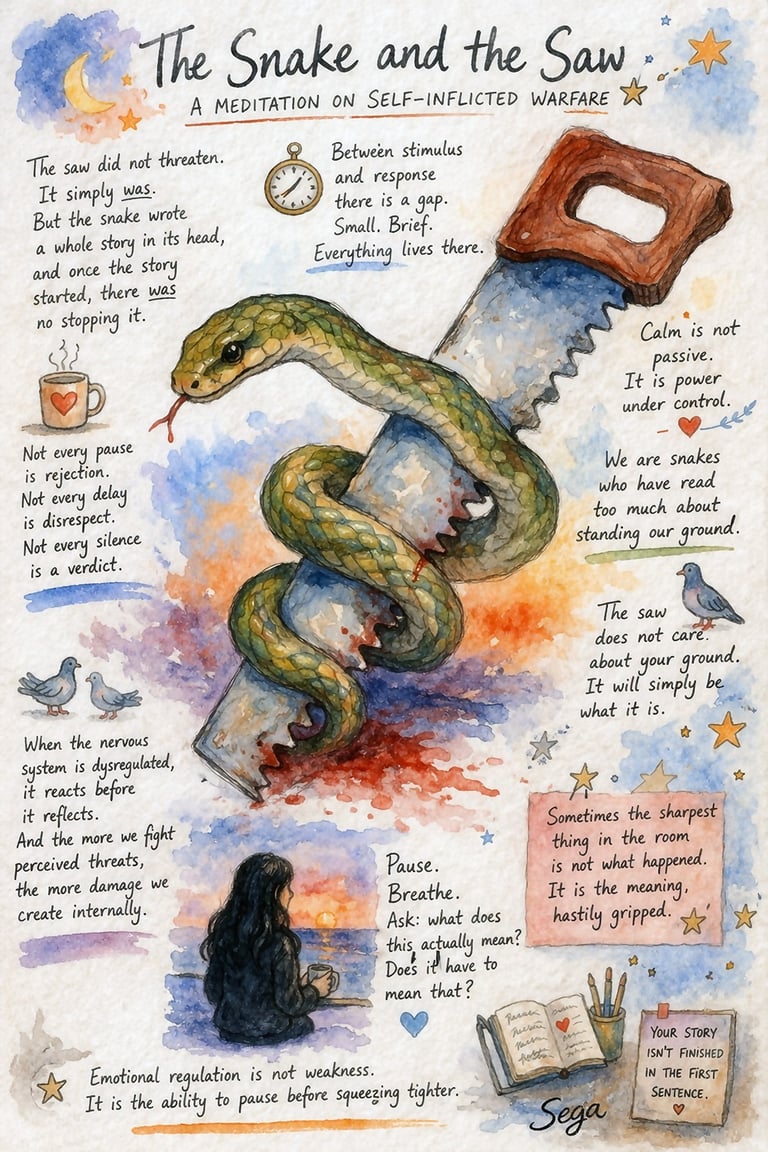
Sometimes the sharpest thing in the room is not what happened.
It is the meaning, hastily gripped.
Sei Pippi, nicht Annika
Explore creativity through words, art, and music.
© 2024. All rights reserved.